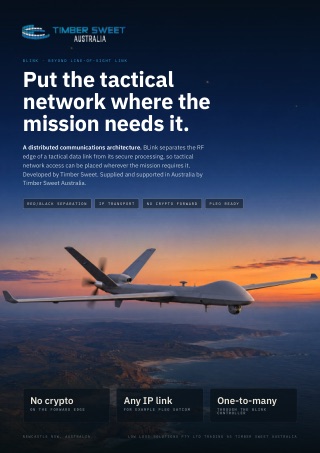
New platforms and nodes
BLink enables tactical communications to and from new platforms and nodes that have never been able to support this capability.
Beyond Line-of-Sight Link
A distributed communications architecture that geographically separates the RF edge of a tactical data link from its secure processing, allowing tactical network access to be placed wherever the mission requires it. Using IP transport between distributed radio components, BLink extends, relocates or creates tactical network coverage without changes to the existing tactical network or its participants.

BLink enables tactical communications to and from new platforms and nodes that have never been able to support this capability.
Smaller size, lower weight, an affordable price and no crypto or CCI on the forward node allow deployment at ranges and scale that were previously impossible.
Extends, relocates or creates coverage over IP transport, with no changes to the existing tactical network or its participants.
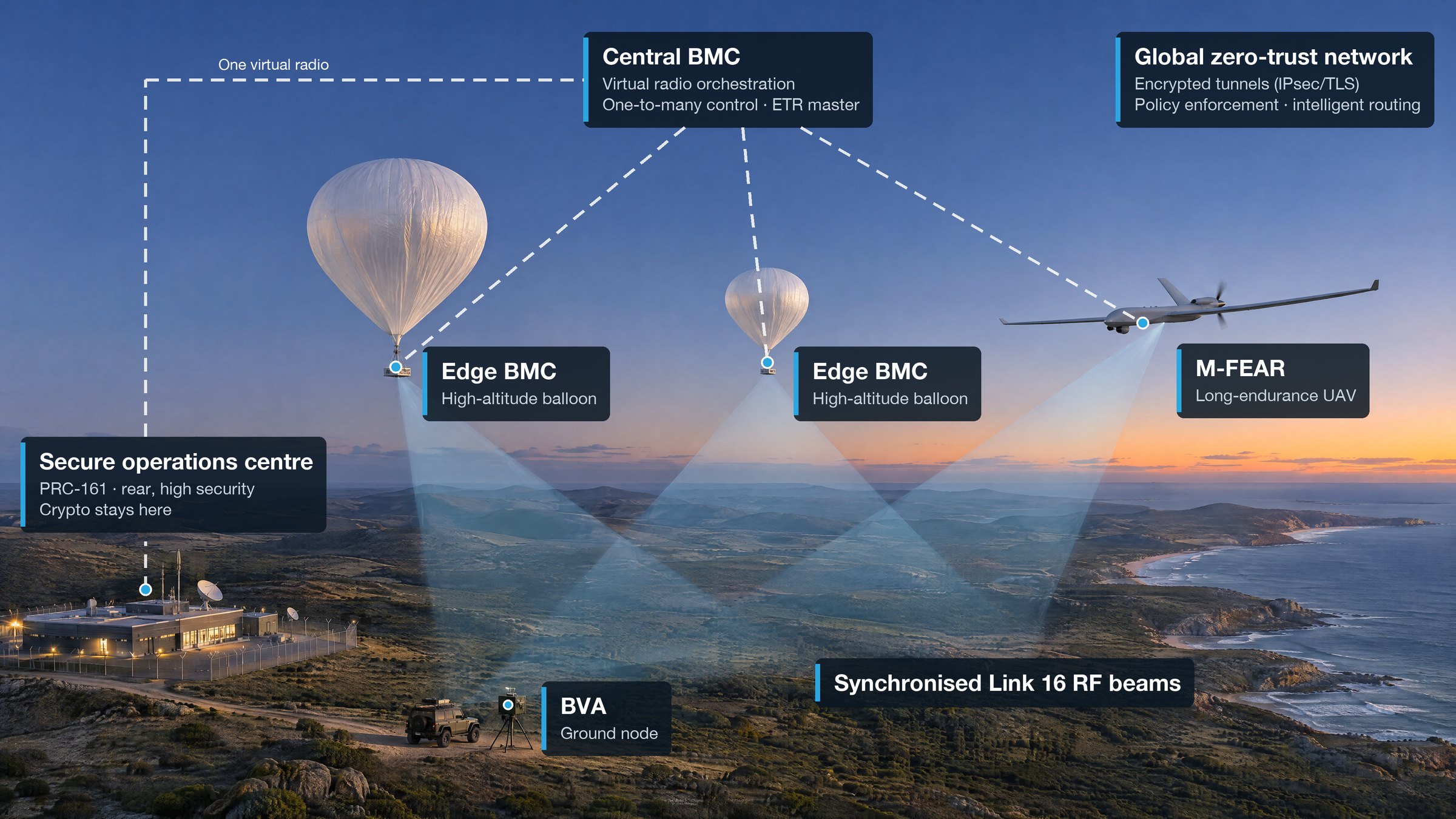
The BLink Multi-point Controller (BMC) enables one-to-many Link 16 operations and virtual radio operations.
The key enabler behind BLink is the ability to separate the red side and the black side of the tactical radio. In a legacy tactical radio, the entire box is a Controlled Cryptographic Item. With BLink, the black-side components sit at the forward edge with no crypto, while all crypto and CCI remain safe at home, connected over an IP link such as SATCOM.
The expansion of proliferated low Earth orbit (pLEO) satellite communication networks has made this capability possible around the world.
| Component | Role | What it does |
|---|---|---|
| M-FEAR | The distributed RF edge | Miniature, affordable tactical RF node that moves the tactical network RF boundary onto aircraft, UAS, ground nodes and other forward platforms. |
| BMC | The distributed network control layer | Enables one-to-many operation, virtual radios and centralised management of distributed BLink nodes. |
| PULSE-M | The spectrum awareness and assurance layer | Distributed monitoring of Link 16 activity, network density and potential interference, all without crypto. |
| Architecture | Distributed: RF edge geographically separated from secure (red side) processing |
|---|---|
| Transport | IP transport between distributed radio components (for example SATCOM) |
| Forward edge | Black-side components only; no crypto or CCI on the forward node |
| Components | M-FEAR (distributed RF edge), BMC (network control layer), PULSE-M (spectrum awareness and assurance layer) |
| Expansion |
|
Specifications as published by Timber Sweet and subject to change. Full technical detail is available from Timber Sweet Australia on request.
Expected to be available in Australia from mid 2027, together with the support equipment and operator training. Register your interest now and we will keep you updated.
| Item | Part number |
|---|---|
| M-FEAR | TSC-MFR-001 |
| BLink Multi-point Controller (BMC) | TSC-BLK-003 |
| M-FEAR support equipment | LITE KIT:MFEAR |