
The problem
Link 16 shares its band with civil aviation.
Link 16 operates in 960 to 1215 MHz, the band set aside worldwide for aeronautical radio-navigation. Its use is governed by frequency clearance agreements, so pulse density has to stay within agreed limits.
- Today, TSDF is calculated, not measured when a Link 16 network monitor tool isn't used. It's derived from every time slot a platform is assigned, so it describes the worst case, not what was actually transmitted.
- Worst-case planning means large safety margins. Fewer platforms, tighter networks and harder clearances for training and exercises.
- PULSE-M measures what actually happens. True TSDF from live pulses in the open air, with a permanent digital record you can share with network designers, range managers and authorities.
Link 16 in 60 seconds
One tactical picture. Thousands of pulses every second.
Air, sea, land and command platforms share one picture over Link 16, taking turns to transmit in time slots and hopping across frequencies. PULSE-M sits on the ground and listens to all of it, without joining the network. Select a platform.
Network
A shared tactical picture
Each platform transmits in its assigned time slots and receives everyone else's. The result is one common picture across air, sea and land.
Select a platform on the diagram
Time slots (TDMA)
12-second frame of 1,536 time slots, each 7.8125 ms, interleaved into sets A, B and C. Platforms only transmit in the slots they're assigned.
Frequency hopping
51 frequencies from 969 to 1206 MHz, 3 MHz apart. Nothing is transmitted from 1008 to 1053 MHz or 1065 to 1113 MHz, keeping 1030 and 1090 MHz clear for IFF and TCAS.
Time slot duty factor
TSDF measures pulse density in a geographic area: total use as a share of 396,288 possible pulses per 12 seconds, and the share any single user may take.
Link 16 figures: Northrop Grumman, Understanding Voice and Data Link Networking (Dec 2014, approved for public release 13-2457).
Capability
Complete monitoring of the airborne navigation spectrum.
True TSDF, measured
Directly measures time slot duty factor from live pulses in the open air, moving from assumed usage to actual measured usage.
Protect aids to navigation
Monitors down to the lowest level transmission and alerts users to potential interference at or near aids to navigation, or other sensitive equipment and locations.
Detect rogue networks and users
Compares real-world activity with traditional network monitoring tools to identify rogue users, split networks, missing participants and other anomalies.
No COMSEC. No crypto.
Not a Controlled Cryptographic Item, and doesn't use or require crypto, so systems are easily stored, transported and operated.
Operating in five minutes
Single-person portable and rugged. The system can be set up and operational within five minutes.
A record you can share
Produces a permanent digital record for network designers, range and spectrum managers and program managers, through an open, software-upgradable architecture.
The kit
Everything in one case.
Commercial off-the-shelf hardware in a rugged, foam-fitted case, ready to deploy at a range, an air base or an exercise site.
Click any component to view it in 3D
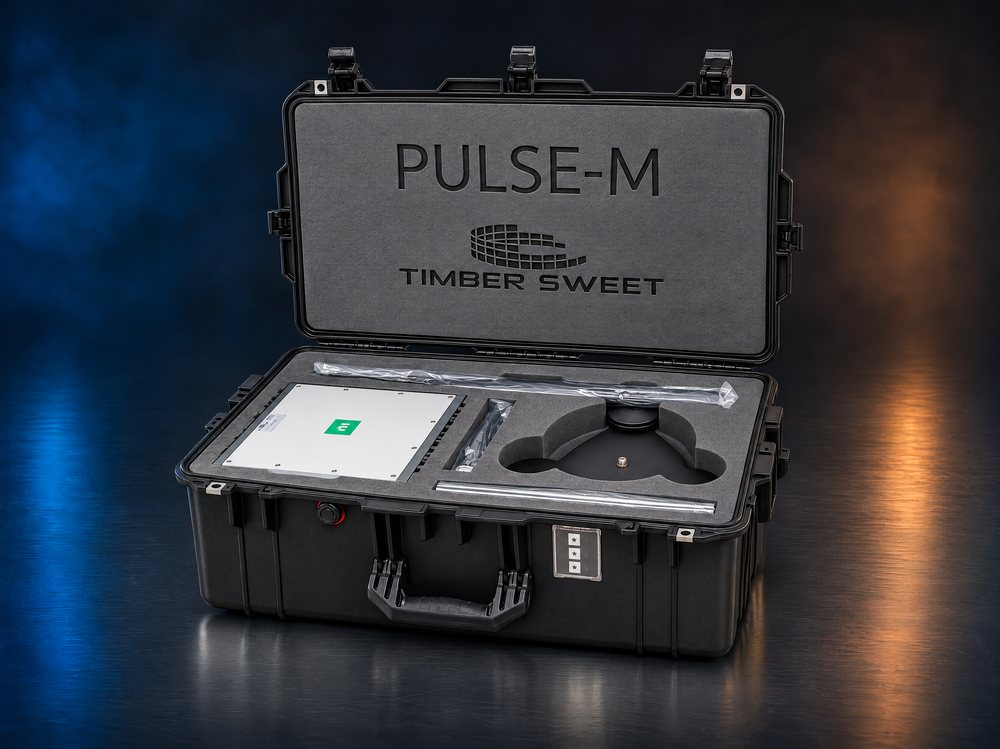


Full technical specification available from Timber Sweet Australia on request.
In the field
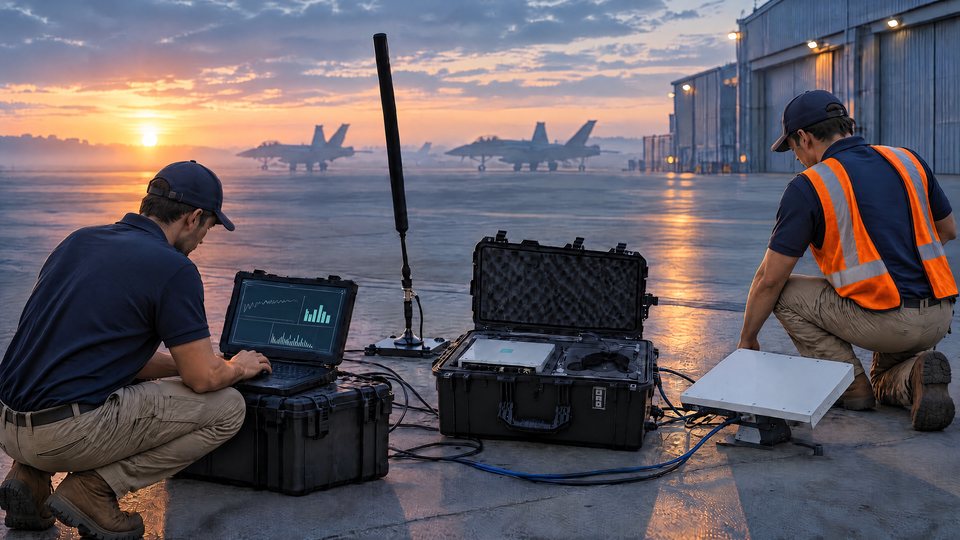
Set up in minutes, wherever the network operates.
Single-person portable and rugged, PULSE-M is set up and monitoring within five minutes at a range, an air base or an exercise site.

Who uses it
Built for the people who plan, run and clear Link 16.
Range and spectrum managers
Measure and manage total TSDF to keep networks inside frequency clearance limits, with evidence.
Exercise planners
Plan training and exercises on measured data, and reduce compliance-related cancellations.
Network designers and JICOs
Find split networks, rogue platforms and missing participants by comparing live pulses with the plan.
Sensitive sites
Watch for potential interference at or near aids to navigation and other sensitive equipment.

Developed in the USA. Supplied and supported in Australia.
PULSE-M is designed and manufactured by Timber Sweet in the United States. Low Loss Solutions Pty Ltd trading as Timber Sweet Australia supplies and supports it in Australia, with local training and Link 16 expertise. For U.S. and other international enquiries, please contact Timber Sweet.
Questions
Does PULSE-M need crypto or COMSEC handling?
No. PULSE-M isn't a Controlled Cryptographic Item and doesn't use or require crypto, so it can be stored, transported and operated without COMSEC handling.
Does it transmit or join the network?
No. PULSE-M is a passive monitor. It listens to the band and measures live pulses without joining or affecting the Link 16 network.
How long does it take to set up?
The system is single-person portable and can be set up and operational within five minutes.
Can we buy it, or use it as a service?
Both. Timber Sweet offers PULSE-M systems for purchase and fielding, or as a monitoring service. Talk to Timber Sweet Australia about the right option for your program in Australia.
Who supports it in Australia?
Timber Sweet Australia, based in Newcastle NSW, supplies PULSE-M in Australia and provides local support and training.
Contact us
Talk to Timber Sweet Australia about PULSE-M.
Ask for a demonstration, a quote or the full technical specification. A director will come back to you.
Email enquiries [at] lowlosssolutions.com.au
Timber Sweet Australia · Newcastle NSW